
CoachSuit blog
Published August 4, 2026
My PT Hub vs Trainerize: The 2026 Comparison
Seventy-one percent of professionals across the fitness industry run their businesses through online coaching software. You launch with a handful of clients, tracking progress in spreadsheets and delivering workout PDFs via email, but manual tracking breaks down and forces you onto a dedicated platform when your roster grows to thirty people.
Use this 2026 My PT Hub vs Trainerize comparison to uncover hidden costs and see why CoachSuit’s lifetime license beats the endless SaaS trap.
The shift in online coaching
Clients drive technology adoption across the fitness industry. An Industry Research report shows 43% of fitness enthusiasts now prefer hybrid training models that blend in-person sessions with digital programming. Delivering this hybrid experience requires structured software to assign a mesocycle, track the weights lifted on Tuesday, and verify the client's macro compliance on Friday. You need a centralized system, but the available solutions often punish the exact business growth they claim to support.
Fitness software vendors rely on a tiered rental model that obscures the long-term financial impact. Vendors advertise sticker prices between $9 and $26 to acquire users at the start of their journey. Once you load your exercise library, build templates, and onboard active clients, these vendors lock you into their ecosystem. As your roster expands from thirty to one hundred clients, those platforms automatically bump you to higher billing tiers, which means the software you rented for pocket change now costs thousands of dollars a year.
You do not have to rent your core business infrastructure forever. CoachSuit offers an alternative path for professionals ready to scale an online coaching business without compounding overhead. The platform provides a lifetime license for a one-time build fee of €7,000, securing a fully branded iOS and Android application that accommodates infinite clients. Replacing recurring fees with permanent ownership builds your delivery system into a permanent business asset rather than an ongoing liability.
Audit your current operational stack today by counting exactly how many separate applications your clients must touch to work with you, including messaging apps, nutrition trackers, and payment gateways. Every external touchpoint introduces friction that lowers compliance and increases client churn.
Base pricing and scalability: penalizing your growth
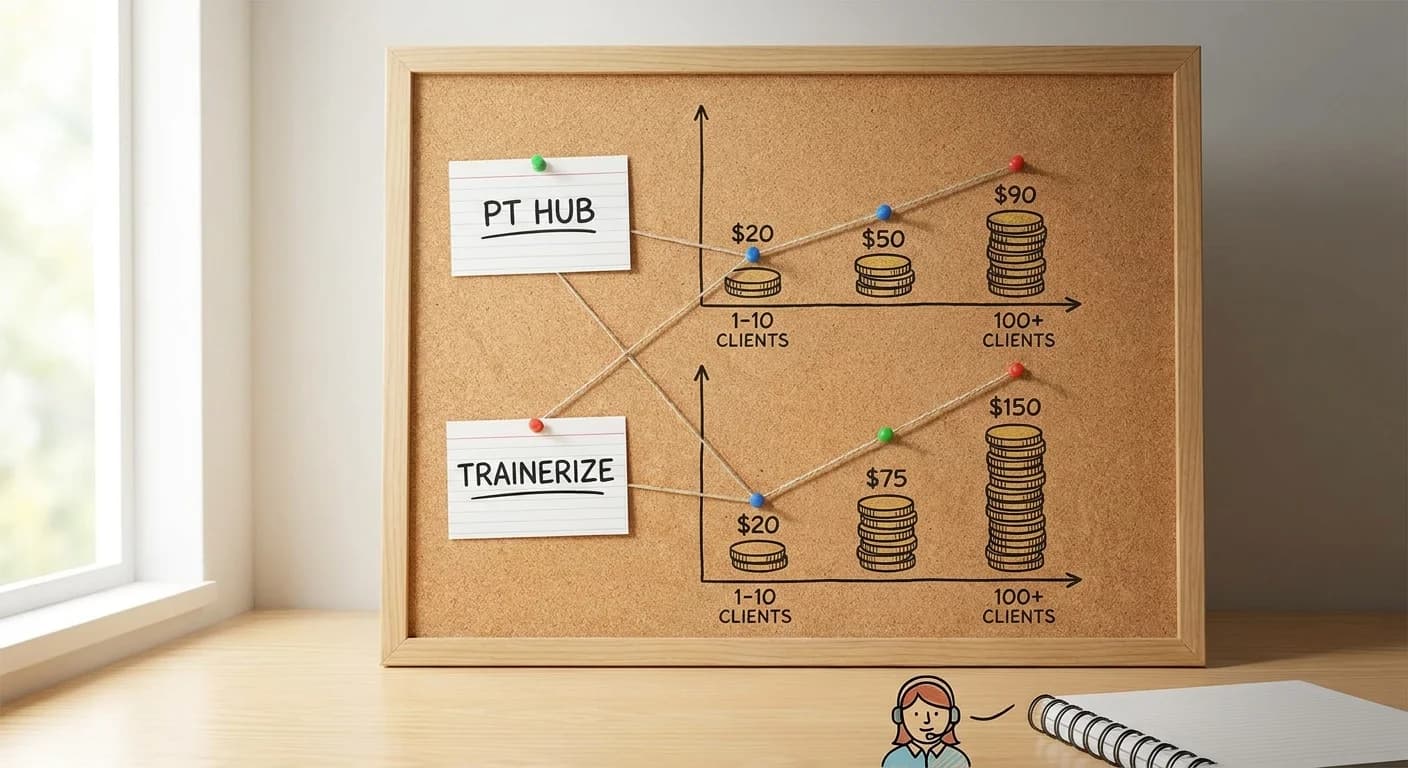
Base subscriptions dictate your operational overhead, and legacy platforms structure these fees to scale alongside your revenue. Trainerize links your monthly bill directly to your active client count, charging $23 per month for five clients. This entry tier accommodates part-time trainers, but hitting 100 clients pushes you onto the Pro plan at $118 per month. Scaling to 400 clients requires the Pro+ plan at $248 per month, so every successful marketing campaign triggers an automatic software price hike.
My PT Hub takes a different approach to base billing by focusing on feature gating rather than strict client caps on its main tier. The Starter plan costs $40 per month but imposes a strict limit of three clients, forcing any working professional into the Premium plan. At $105 per month, Premium removes the client cap and offers unlimited growth. For a coach managing 200 clients, this flat rate provides more predictable overhead than Trainerize's tiered penalty, provided you accept the lack of full brand customization.
Factoring in necessary add-ons makes the financial reality steeper. Industry data confirms that adding payment processing and basic white-labeling pushes these advertised base prices higher, damaging your profitability margins by handing $2,000 to $4,000 back to software vendors every year. Paying these fees makes sense during your first six months of operation, but continuing to rent the software in your third year destroys capital you could reinvest in marketing.
Open a spreadsheet and calculate your 36-month software cost right now. Multiply your current monthly software bill by 36, then add 20% to account for tier upgrades as you acquire more clients over that period. Documenting the total cost of renting software over a three-year window clarifies the value of permanent ownership.
White-label apps and brand authority
Clients paying premium rates expect an experience that matches the price tag, so handing a high-ticket client a generic application displaying a third-party vendor logo damages your brand authority before they log their first workout. To keep clients interacting entirely within your branded ecosystem, you must secure a pure white-label app, which requires expensive upgrades on both legacy platforms.
Trainerize guards its custom app feature by requiring a Pro tier subscription at a minimum of $118 per month, plus an additional setup fee to remove their branding from the user interface. The My PT Hub pricing structure operates similarly, requiring an upgrade to their Ultimate tier and pushing your monthly software bill to $329.
CoachSuit changes the financial mechanics of brand ownership. The CoachSuit pricing model charges a straightforward €7,000 one-time build fee that covers the complete development of your branded mobile application.
Calculate the long-term ROI on brand ownership by comparing the My PT Hub Ultimate tier, which costs nearly $12,000 over three years to maintain your app store presence, against CoachSuit. The lifetime model saves you $5,000 in that same window while delivering a superior asset, allowing you to bypass the rental trap and deploy a digital experience that justifies higher coaching rates.
Check your current client app icon on your own phone. If your clients tap a logo that does not belong to your business, draft a transition plan to deploy a white-label fitness app before your next billing cycle renews.
Workout programming and client experience
Delivering physical results requires structured programming, but the digital interface dictates whether clients log those workouts. A direct My PT Hub vs Trainerize comparison shows two distinct approaches to managing the training floor, where you need an efficient template builder combined with granular control over rest periods, tempo, and supersets to push client progression.
Trainerize excels at complex athletic programming by handling intricate routines and integrating with major wearables like Apple Watch and Garmin. Heart rate data, daily step counts, and sleep metrics flow directly from the client's wrist to your central dashboard, helping you structure workout plans based on objective recovery metrics rather than subjective weekly check-in forms.
My PT Hub functions as a budget-friendly, all-in-one suite that prioritizes breadth of features over programming depth. While the workout builder manages standard resistance training, the platform shines by bundling nutrition tracking and live class bookings into the core software package. Coaches running large bootcamps use this native scheduling feature to manage physical capacity without paying for a separate studio booking system.
Regardless of the platform's capabilities, poor configuration causes app fatigue. When clients have to check WhatsApp for coaching feedback, open a PDF for a grocery list, and log into a separate app to record a bench press, they eventually stop tracking, and this fragmented delivery guarantees high client churn.
Consolidate your client communication channels. Move all direct messages, check-in forms, and progress photo submissions inside your central coaching application. Delete secondary communication channels and train your clients to use the primary app for all touchpoints. For more on that delivery problem, see online coaching app vs PDFs and WhatsApp.
Payments, nutrition, and 2026 AI automation
Collecting revenue introduces another layer of hidden fees when renting legacy software. Trainerize charges a $10 monthly add-on fee to activate the payment processing module, sitting on top of the standard Stripe transaction costs of 2.9% plus thirty cents per charge, though this rate increases for international cards and currency conversions. My PT Hub integrates Stripe processing natively into all tiers without levying an additional monthly surcharge, though neither platform handles external bank transfers well.
Nutrition tracking technology shifted away from manual entry throughout 2025 and 2026, and both platforms now utilize AI-powered barcode scanners and food-photo recognition to simplify macro logging. You assign daily calorie targets and deliver custom recipe packs while the software handles compliance checks, reducing your administrative workload by pinging clients who miss scheduled workouts or skip meal logging.
Software features only provide an empty container, because your proprietary content delivers the value. Most beginner coaches rely on the stock exercise video libraries provided by their software vendor, creating a generic user experience that clients recognize. A client paying high-ticket prices expects custom guidance, and seeing a generic stock model demonstrate a squat devalues your service.
Rent a clean studio space for one afternoon this week. Film high-resolution, branded video demonstrations of the fifty core movements you prescribe most often, ensuring your form cues match your coaching philosophy. Upload these proprietary video assets to replace the generic stock library, elevating the perceived value of your programming.
Final verdict: My PT Hub vs Trainerize vs CoachSuit
Evaluating coaching software requires looking past marketing copy and calculating the true cost of operation at scale to determine your long-term profitability.
Choose Trainerize if you operate a technical, small-roster business that demands granular data tracking. The robust wearable integrations and detailed workout builder serve data-driven coaches well, provided the client count stays low enough to avoid triggering the expensive upper pricing tiers.
Choose My PT Hub if you need a budget-friendly option for high-volume group coaching or bootcamps. The unlimited Premium plan controls your monthly overhead, and the built-in class scheduler handles group management. Accepting this platform means full brand customization will cost you more in the long run.
Choose CoachSuit when you run a scaling online coaching business and want to own your digital presence. Renting software makes sense during your first year of operation, but paying a software company $4,000 annually in your fifth year destroys wealth. By replacing recurring monthly fees with a single software asset you own outright, you deploy a pristine, white-labeled mobile experience that handles unlimited clients without increasing your bill.
Download your current client roster list as a CSV file today. Count your active paying members, multiply that number by your growth goal for the next twelve months, and map that final number against the pricing tiers above to select the platform that protects your margins.
Final takeaway
My PT Hub and Trainerize can both work depending on roster size, programming depth, and how much brand control you need. Trainerize fits data-driven coaches with smaller client counts. My PT Hub fits higher-volume group coaching when a flat Premium plan keeps overhead predictable.
Both still operate as monthly SaaS rentals. As you scale, tier upgrades, white-label fees, and add-ons compound into thousands of dollars a year.
If you want a fully branded iOS and Android app with unlimited clients and no recurring platform rent, CoachSuit’s one-time lifetime license turns your delivery stack into a business asset instead of an ongoing liability.
My PT Hub vs Trainerize FAQ
- Which is cheaper for 100 clients: My PT Hub or Trainerize?
- At around 100 clients, My PT Hub Premium at about $105/month is slightly lower than Trainerize Pro at about $118/month. Total cost still depends on white-label upgrades and payment add-ons.
- Does Trainerize charge more as you add clients?
- Yes. Trainerize ties monthly pricing to active client count, so growth can move you into higher plans such as Pro and Pro+.
- Does My PT Hub have unlimited clients?
- My PT Hub Starter is capped at three clients. Premium removes the client cap and offers unlimited growth at a flat monthly rate.
- How much does a fully branded app cost on these platforms?
- Trainerize typically requires Pro pricing plus a setup fee for a custom app. My PT Hub pushes full branding toward the Ultimate tier around $329/month. CoachSuit includes a fully branded app in a one-time €7,000 build fee.
- When does CoachSuit make more sense than My PT Hub or Trainerize?
- CoachSuit fits coaches who want to own a branded mobile experience, scale without client-based price hikes, and replace recurring SaaS rent with a lifetime license.
- Do My PT Hub and Trainerize both support Stripe payments?
- Yes. Trainerize adds a $10/month payment module on top of Stripe fees. My PT Hub integrates Stripe without that extra monthly surcharge.
Stop renting your business infrastructure
Secure a lifetime software license and launch a fully branded, white-label fitness app that scales with zero monthly platform fees.
View CoachSuit pricing