
CoachSuit blog
Published June 7, 2026
Online Coaching App vs PDFs and WhatsApp
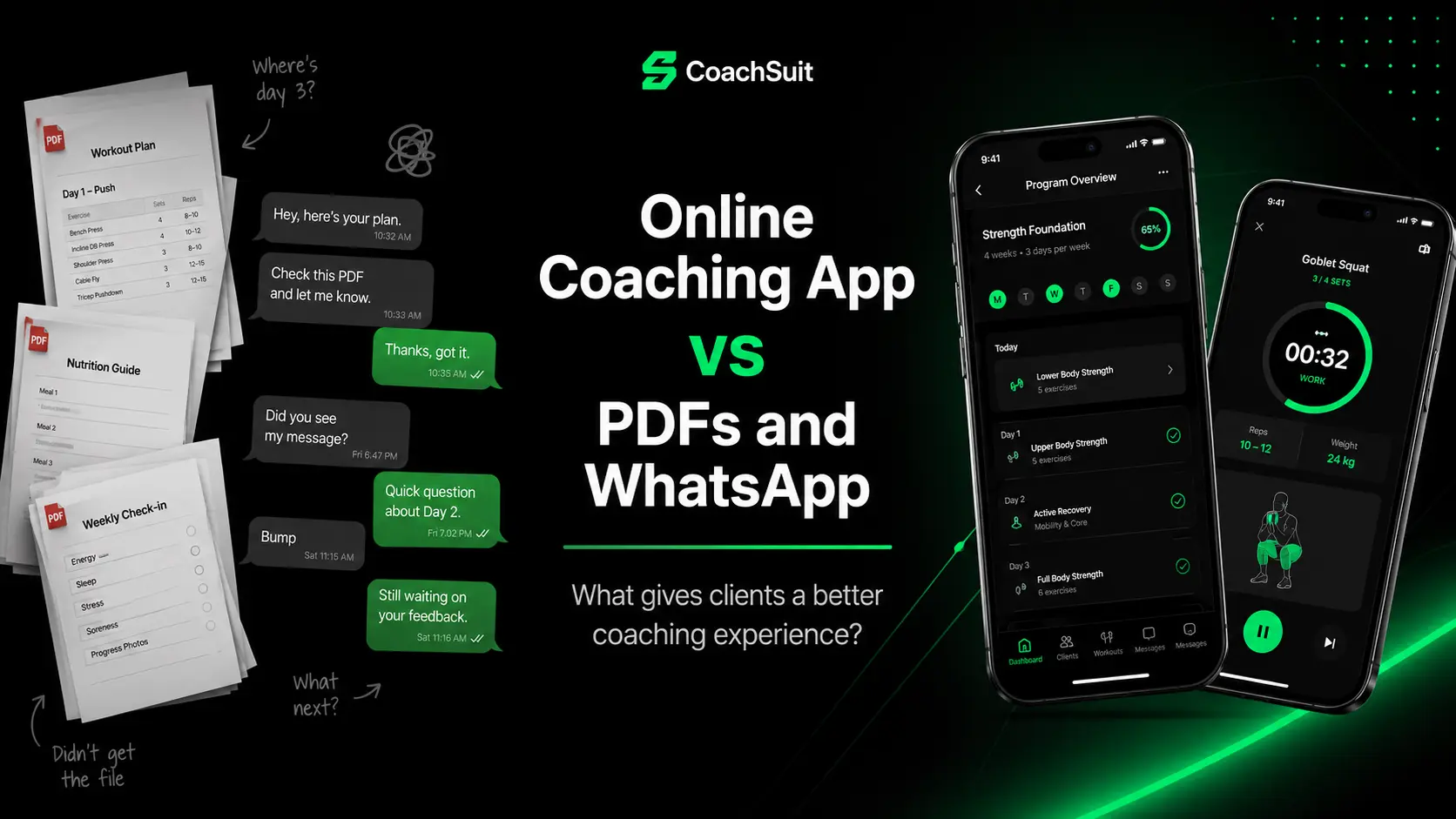
Many personal trainers and online coaches start by delivering workouts through PDFs, WhatsApp messages, email attachments and spreadsheets. It is a familiar workflow that requires no new software and lets you begin coaching quickly.
That approach can work well in the early stages, especially with a small client base and a simple offer. As coaching grows, the same tools that felt fast at the start can become harder to manage. Content spreads across folders and chat threads, clients ask for the same files again and follow-ups start to repeat.
Clients need clarity, structure and easy access to training content between sessions. When workouts, exercise guidance, nutrition ideas and progress updates live in different places, even good coaching can feel scattered from the client side.
This article compares PDFs, WhatsApp and a dedicated online coaching app so you can decide what fits your coaching model, client expectations and business stage.
Why many online coaches start with PDFs and WhatsApp
PDFs and WhatsApp are popular starting points for good reasons. They are fast to set up, require no new system and most trainers already know how to use them. You can write a workout, export a PDF, send it in a message and start coaching the same day.
For the first few clients, that workflow often feels enough. You can answer questions directly, adjust plans in conversation and keep things personal without learning new software.
The challenge usually appears when coaching needs more structure, repeatability and clarity. As client numbers grow and programs become more detailed, the same tools that helped you launch can start creating admin work, confusion and inconsistent client experiences.
PDFs and WhatsApp are useful tools. They are just not always enough on their own when you want a complete, organized coaching delivery experience.
Where PDFs work well
PDFs remain a practical format for many coaching tasks. They work well for simple documents, one-time guides and static instructions that do not need frequent updates.
They are easy to export from your existing tools, share by email or message and use as downloadable resources. Many trainers use PDFs effectively for lead magnets, onboarding documents or reference guides that clients can save locally.
The limitations show up when coaching becomes ongoing and dynamic. Once a PDF is sent, updating it means creating a new file and making sure clients replace the old version. Clients may lose files, open outdated plans or struggle to know which document is current after several weeks.
PDFs are also not interactive. They do not connect naturally to exercise videos, logged workouts or progress history. For one-time content they can be excellent. For day-to-day workout delivery they often become harder to maintain.
- Good for static guides and reference documents
- Easy to export and share quickly
- Useful for lead magnets and downloadable resources
- Hard to update after sending without creating confusion
- Not ideal for ongoing, structured workout delivery
Where WhatsApp works well
WhatsApp excels at quick, direct communication. It is familiar to most clients, works on every phone and supports the personal relationship that many coaches build through regular contact.
It is useful for answering questions between sessions, sending short reminders, sharing encouragement and handling the human side of coaching that no app replaces entirely.
For early-stage coaching with a small number of clients, WhatsApp can feel natural and efficient. You stay close to the conversation and clients know exactly where to reach you.
The limitations appear when important coaching content mixes with casual messages. Workout plans, video links, recipe files and progress questions can get buried in long chat threads. Clients may miss instructions, forget which message contained the current plan or struggle to find an exercise explanation you sent weeks ago.
WhatsApp also becomes harder to organize as client numbers grow. Follow-ups can turn repetitive when multiple clients ask similar questions, and the trainer ends up resending the same explanations again.
Where scattered coaching delivery starts to break down
The practical problems often appear gradually. Clients ask for the same PDF again because they cannot find it. They are unsure which workout is current after you sent an updated version. They miss a message with important instructions buried between everyday chat.
On the trainer side, you repeat explanations you have already given to other clients. Progress updates sit in messages, notes and separate files rather than one organized view. The quality of the client experience starts to depend too much on manual follow-up.
Consider a common scenario: a client receives a PDF workout, a WhatsApp explanation of exercise substitutions, a video link for form reference, a recipe file for nutrition support and progress questions in separate messages over several days. Even if every piece of content is good, the experience can feel fragmented.
This is not a failure of your coaching. It is often a delivery problem. When content lives in too many places, clients spend energy finding information instead of following the plan.
What an online coaching app changes
An online coaching app centralizes the client-facing coaching experience. Instead of searching through files and messages, clients open one place on their phone for workouts, programs, exercise guidance and recorded progress.
For the trainer, an app supports more structured content delivery. Programs can be organized clearly, exercise guidance can stay connected to the workout the client is doing and nutrition content can sit alongside training rather than in a separate folder.
The app becomes the home for coaching content between sessions. That does not remove the need for personal communication, but it reduces how much important information depends on chat history and manual resends.
A dedicated mobile app experience also creates a clearer boundary between coaching content and casual messaging. Clients know where to find today's workout, how to review an exercise and where to log what they completed.
Workout delivery: PDF plan vs app program
PDF workout plans are static by nature. They are easy to send and simple for clients who prefer a printable format. Once sent, however, they are harder to update without creating version confusion. After several weeks, clients may not know whether they are following the latest plan or an older file saved on their phone.
Structured workout program delivery inside an app gives clients a clearer path through training. Programs can be organized into weeks and sessions, workouts appear in order and clients can follow the plan from their phone without asking you to resend files.
Apps are often a better fit for repeatable programs, remote clients and coaching models where clients train independently between check-ins. PDFs can still work as supplements, but they are less ideal as the primary delivery method for ongoing training.
The right choice depends on how often plans change, how much structure your clients need and whether you want clients to follow programs inside one organized experience.
Exercise guidance: message explanations vs video library
WhatsApp explanations are helpful for quick clarification. A client asks about tempo, equipment substitutions or exercise setup and you answer directly. That personal touch matters and can resolve confusion fast.
The problem is that the same explanations often get repeated for multiple clients, and older answers become hard to find in chat history. A client training alone on a Tuesday evening may not want to scroll through weeks of messages to locate a video link you sent once.
An organized exercise library with exercise video guidance and written instructions gives clients a reference they can revisit whenever they need it. Videos and cues stay connected to the exercise inside the workout, which is especially useful for remote clients training without direct supervision.
Exercise guidance in an app does not replace hands-on coaching or live form correction. It gives clients a clearer reference point when you are not in the room, which can reduce repeated back-and-forth messages over time.
Nutrition content: files vs recipes and meals in the app
Nutrition support varies widely between coaches. Some trainers only share simple recipe ideas occasionally. Others include more nutrition education as part of the coaching relationship. Your delivery method should match what you actually offer, not what a feature list suggests you should provide.
With PDFs and messages, nutrition content often arrives as separate files or links disconnected from the training plan. Clients may save a recipe PDF in one folder and their workout plan in another, which makes the overall experience feel less connected.
Keeping recipes and meals inside the app can bring training and nutrition content closer together. Clients who receive practical food support can find those resources in the same place they access workouts and exercise guidance.
CoachSuit supports recipes and meals as nutrition content inside the app. It is not positioned as a meal plan generator, calorie tracker or macro tracking tool. If your nutrition support is guidance and practical food ideas, in-app recipes and meals may fit your offer without adding complexity clients do not need.
Progress tracking: manual check-ins vs recorded progress
Manual check-ins through messages or calls are flexible and personal. Many coaches prefer conversational progress reviews, especially with smaller client bases or highly personalized offers.
The trade-off is consistency and visibility. Progress notes may sit across WhatsApp threads, voice notes, spreadsheets and memory. When data is scattered, it becomes harder to review training history quickly or spot patterns before a scheduled check-in.
Recorded client progress tracking inside an app can organize training history and logged activity in one place. That helps both you and your clients see what has been completed over time.
Progress visibility supports better conversations, but it does not guarantee results. The value is organization and clarity, not a promise that one metric alone will define client outcomes.
Brand experience: generic tools vs branded coaching app
PDFs and WhatsApp usually feel generic from the client perspective. The experience is tied to everyday tools rather than your coaching business. That can be fine early on, but it may not match the professional impression you want as your offer matures.
A branded coaching app connects the client experience to your logo, colors and visual identity. Clients open an app that feels like an extension of your business rather than a collection of files and chat threads.
Branding matters when you care about consistent delivery, premium positioning and a client experience that reflects the quality of your coaching. It is especially relevant for online coaches who rarely meet clients in person and need the digital experience to carry more of the relationship.
If brand consistency is part of your growth plan, CoachSuit for personal trainers and similar branded app approaches can make the coaching experience feel more intentional on mobile.
When PDFs and WhatsApp are still enough
PDFs and WhatsApp may still be the right choice in several situations. If you have very few clients, a simple offer and no need for structured program delivery, the manual workflow may cost less time than setting up a new system.
Some coaches prefer to stay fully manual because their coaching is highly conversational and changes frequently session to session. Others are testing their offer and are not ready to invest in a branded app until the business model is clearer.
If your clients are satisfied with files and messages, your admin load is manageable and you do not need organized progress visibility, there is no requirement to change tools immediately.
Being honest about this builds trust. A coaching app is a practical upgrade for many trainers, but it is not mandatory for every business stage.
When an online coaching app makes more sense
An online fitness coaching app tends to make more sense when you deliver repeatable programs, work with remote clients or want a clearer client experience than files and messages can provide.
It is often worth considering when you want training content, exercise guidance, nutrition resources and progress visibility in one place rather than spread across separate tools.
Brand consistency is another signal. If clients pay for a structured coaching relationship and expect a professional mobile experience, a fitness app for coaches with your branding may fit better than generic delivery tools.
You may also be preparing to scale beyond fully manual delivery. As client numbers grow, structured content inside a workout program app can reduce repeated admin and make the experience more consistent.
If you are at this stage, it can help to compare personal trainer apps based on your delivery needs, branding goals and launch expectations rather than feature marketing alone.
For related reading, see Branded Fitness App vs Generic Coaching App, Personal Trainer App Features and Best Way to Deliver Workout Programs to Clients Online.
Where CoachSuit fits
CoachSuit is built for personal trainers, online coaches and gyms that want a branded mobile app experience rather than scattered files and messages. Depending on selected modules, it can support workouts, programs, exercise guidance, recipes, meals and recorded progress inside one client-facing app.
The platform helps move coaching content into a branded iOS and Android app personalized around your logo, colors and visual identity. Initial design personalization and launch support are included, with ongoing maintenance and priority support available through CoachSuit Club.
A typical launch takes 2-4 weeks depending on modules, content preparation and feedback speed. That range is useful for planning, but your timeline may differ based on how ready your content is when setup begins.
CoachSuit may not be necessary if you only need a simple PDF and chat workflow. If you want a structured online coaching platform with branded mobile delivery, review pricing and launch options or book a free demo to discuss modules and branding direction.
Final takeaway
PDFs and WhatsApp are useful starting tools for many personal trainers and online coaches. They are fast, familiar and often enough for early-stage delivery.
They become harder to manage as coaching becomes more structured, client numbers grow and the experience needs clearer organization around workouts, guidance and progress.
An online coaching app can improve content delivery, client access and brand consistency when your coaching model benefits from a dedicated mobile experience.
The right choice depends on your coaching model, client expectations and business stage. Compare what you deliver today with what you want clients to experience tomorrow, then choose the workflow that supports that goal.
Online coaching app FAQ
- Is WhatsApp enough for online coaching?
- WhatsApp can be enough for simple communication and early-stage coaching. It becomes harder when workouts, videos, check-ins, recipes and progress updates are spread across many messages.
- Are PDFs still useful for fitness coaching?
- Yes. PDFs are useful for static guides, lead magnets and simple documents. They are less useful when the coaching experience needs updates, structure, progress visibility and ongoing client interaction.
- What does an online coaching app do better?
- An online coaching app can organize workouts, programs, exercise guidance, recipes and recorded progress in one mobile experience, instead of spreading content across files and messages.
- Does CoachSuit replace WhatsApp?
- CoachSuit can give trainers a more structured app experience for delivering coaching content. Trainers may still use WhatsApp or other tools for direct communication if that fits their workflow.
- Can CoachSuit include nutrition content?
- CoachSuit supports recipes and meals as nutrition content inside the app. It is not presented as a meal plan generator, calorie tracker or macro tracking tool.
- Who should use an online coaching app?
- An online coaching app is useful for trainers and coaches who want structured delivery, branded client experience, mobile access to content and better organization around workouts and progress.
Ready to move beyond scattered coaching delivery?
Book a free CoachSuit demo to discuss your coaching model, app modules, branding direction and launch options.
Book a free demo