
CoachSuit blog
Published June 25, 2026
How to Get Your First Online Coaching Clients in 30 Days
Plenty of fitness coaches know how to write a solid session. The hard part is getting people to buy online. You can be good at programming and keeping clients consistent in the gym, then sit down at a laptop and feel stuck on how to get online coaching clients.
A large following is not the starting line. You do not need to go viral or wait until the grid looks perfect. Many coaches get their first online personal training clients from people they already know, plus a few warm conversations that come from useful content.
The first objective is not attention for its own sake. It is a simple system that consistently creates conversations with potential clients. Attention without a conversation is noise. Conversations without a clear offer stall. An offer without follow-up never turns into paid work.
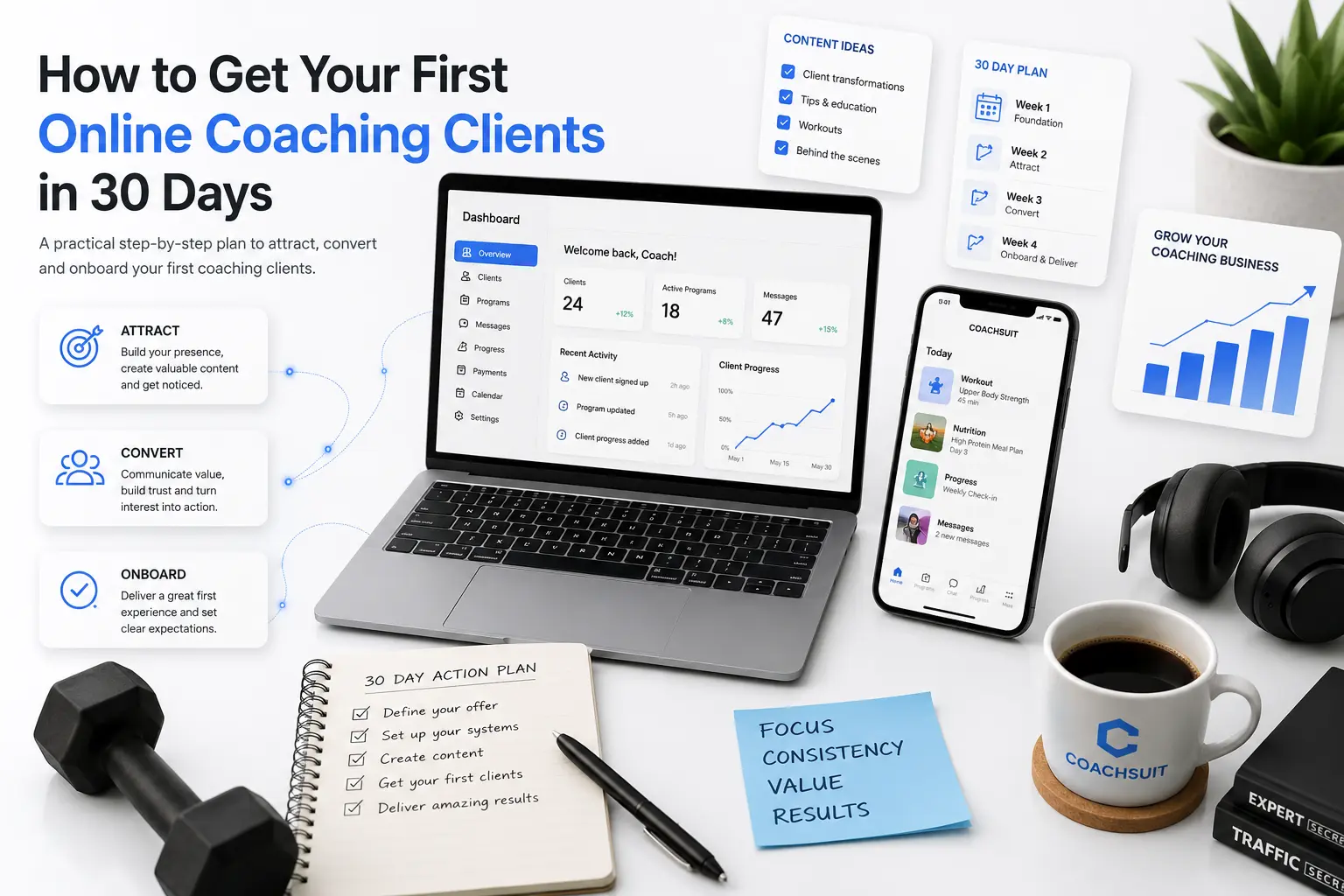
This is a 30-day framework for personal trainers who want their first online coaching clients. It moves from attention to conversations to leads to clients. Treat it as a work plan, not a promise that someone will pay on day 30.
Define Exactly Who You Want to Coach
Trying to coach everyone makes marketing harder than the training. If your message is that you help anyone get fit, a busy parent, a powerlifter and a complete beginner all have to invent their own reason to talk to you. Most will not. Specific positioning makes it obvious who should reply.
Write down a target audience you can describe: life stage, training setting, schedule. Pick one fitness goal, not five. Strength, fat loss, return to training, gym confidence. Add experience level. Beginners need simpler sessions. Intermediate lifters need progression and honest feedback.
List the common problems that keep this person stuck: no plan, messy weeks, confusion in the gym, travel, shift work. Then write the desired outcome in plain language. What would they like to be true in 8 to 12 weeks if they stayed consistent?
Weak positioning: "Online fitness coaching for men and women who want to look and feel better." Specific: "I help office workers who have lifted before, but fell off for a year, get back to three 45-minute strength sessions a week." Another: "I help new mums return to training with short home sessions." For 30 days, pick one lane so content, DMs and calls stay coherent.
Create an Online Coaching Offer People Can Understand
People do not buy coaching as an abstract idea. They buy a package they can picture in their week. If you cannot explain it in a few sentences, they will not take the next step.
Most online fitness coaching offers include some mix of personalized workouts, exercise demonstrations, progress tracking, check-ins, accountability, nutrition guidance, messaging, habit tracking and coaching support. You do not need every item on day one. Decide what is included, how often it happens and where the client finds it. They should know if they get a new workout plan each week or a longer block, how check-ins work and how to ask a question without hunting through old emails.
Features describe the work you do. The outcome describes why it matters. "Three workouts a week with video demos and a Sunday check-in" is a feature list. "A simple plan you can follow in a busy week, with someone reviewing what you actually did" is closer to the outcome. Keep both.
Write a one-page offer: who it is for, what is included, what is not, how long it lasts and how someone starts. That page becomes your landing page, your stories and your discovery call. For a deeper walkthrough, see How to Create an Online Fitness Coaching Offer.
Choose Your Online Coaching Pricing
There is no universal price for online coaching. Copying a friend's number, or a figure you saw on Instagram, usually creates problems later. Price should reflect the target market, how personalized the work is, how much support you give and how you position the offer.
Monthly coaching is simple: ongoing programming, reviews and access. An 8 to 12 week program has a finish line, which can help first-time buyers. Premium coaching usually means fewer clients and more contact. Group coaching can lower the price per person if you can deliver a shared plan with lighter 1:1 time. Beginner offers can be shorter and more structured.
Think about capacity before you pick a number. Daily messaging needs more time than a weekly written review. Look at similar coaches in your market, then price from your support level. Charging too little does not automatically get you clients, and charging more than you can deliver creates a different problem.
For the next 30 days, pick one offer and one price. Do not rebuild the package every few days. How to Price Your Online Coaching Services covers packages in more detail.
Build a Simple Online Presence
When someone finds you online, they decide quickly whether you look like a real coach. They check Instagram, maybe a website or landing page. If those surfaces are messy, the conversation never starts.
Make three things obvious: who you help, what you offer and how someone can work with you. A clear bio beats a clever line. Name the audience and the goal. Mention online personal training or online fitness coaching. Put a CTA in the bio, such as "DM PLAN" or "Book a call from the link," and send that link to a simple landing page.
The page needs a headline, what is included, who it is for, a contact method and space for testimonials if you have them. If you already coach in person, use real stories with permission. If you are new, explain how you assess, program and check in. Process is proof when you do not yet have a long online roster.
Give people one contact method you actually watch. A DM, a form or a calendar link. Personal trainers who already have in-person clients can treat the landing page as the same conversation they already have on the gym floor.
Create Content That Attracts Potential Clients
Content is how strangers learn that you exist. Views without conversations do not pay. For 30 days, post with a job: help the right person recognize themselves, then give them a reason to talk to you.
Rotate five types through the week. Keep a small next step on each post: a question, a DM prompt, a comment keyword or a link. You are trying to start conversations with people who might become fitness coaching clients, not collect views.
Educational content
Teach one idea your audience needs. A short video on a 3-day full body week they can finish in 40 minutes. A carousel on progressing a squat when they cannot add weight every session. Keep it specific. General protein reminders are forgettable.
Problem-focused content
Name the week they already live. "You train Monday and Wednesday, then disappear until the following Monday." "You know what to do in the gym, but you keep rewriting the plan in your notes app." End with a question they can answer, such as what usually knocks the week off.
Proof and testimonials
Use only real stories, with permission. A quote about consistency, an approved photo or a short note about how check-ins felt. If you do not have online clients yet, show an in-person journey or walk through a program you actually delivered. Do not invent results.
Authority content
Show how you make decisions. Why accessories stay simple for beginners. How you adjust a week when sleep is poor. This is a window into your coaching brain, which is what someone is hiring.
Offer content
Once a week, say what you sell. "I have a couple of online coaching spots. You get a plan, video demos, a weekly check-in and messaging for questions. Comment COACH or use the link in my bio." Direct is better than mysterious.
Turn Followers Into Conversations
Followers do not automatically become clients. Someone can like your posts for months and never tell you they want help. Invite the conversation in a way that feels human.
Ask a question that is easy to answer: "How many days can you honestly train this month?" Invite a DM: "Send me your current split and I will tell you if it is too much volume for three days." Invite a comment: "Comment TIME if evenings are your only window." Each of those creates a reply you can continue.
Avoid aggressive selling in the caption. The CTA starts a conversation. Once someone replies, ask one or two questions, give a useful answer, then explain how you work if it still fits.
How to Start Conversations Without Being Spammy
The fastest way to hurt client acquisition is blasting the same sales paragraph to everyone who liked a reel. Warm conversations come from context: a story they replied to, a comment they left, a follower who already watches or someone who asked a real question.
If someone replies "same" to a story about skipped evening sessions, answer that story, then send a short follow-up that refers to what they said. Reply to comments in public. Continue privately only when it still fits the same topic. Existing followers who engage more than once can get a simple, specific note.
Do not send mass copy-paste DMs. Do not open with a pitch. Do not drop a first name into a template and call it personal. Do not follow people only to message a price list.
A realistic DM after a comment: "Hey Maya, saw your comment on the evening workout post. If you want, I can send the 3-day structure I use with clients who train after work. No pitch, just the structure. Want it?" After a story reply: "Thanks for the reply on the travel week story. If you want to talk through online coaching around a messy calendar, message me and I will explain how I work."
Use Your Existing Network
First online coaching clients often come from people you already know. Previous clients, gym members, friends who keep asking for a program, regular followers, colleagues and old contacts are warmer than strangers on Explore. Ignoring that list while you wait for Instagram to "work" is a common stall.
Write the list. Former in-person clients who moved city. Members who travel. Friends who have asked for a plan more than once. People who comment regularly. Coaches who do not offer online work and might refer.
Then tell them, plainly, that you now offer online coaching. Message a former client: "I am taking a few online coaching clients. Same style of programming we used together, delivered remotely with check-ins. If you want that, or know someone who would, I can send details." Post a story with who it is for, what is included and how to reply. Mention it to a member who is about to travel. You are informing people, not cornering them.
Build Social Proof Before You Have Many Clients
You do not need a wall of online transformations before you are allowed to sell. You do need to stay honest.
Previous in-person results, shared with permission, still count. Personal experience can count if you are clear about it. Testimonials can be about clarity of the plan or how check-ins felt, not only photos. A short case study can describe the starting situation, what you programmed and what the client reported, without inventing numbers.
Educational content is proof too. If you can explain a progression clearly, people assume you can coach. Document how you onboard, how you write a first block and how you review a week. Never fabricate testimonials or results.
Create a Simple Sales Process
A messy inbox is not a sales process. Use a simple path: content starts the conversation, the conversation shows if they are a fit, a short qualification step saves time, a discovery call lets you diagnose, then you present the offer and, if they say yes, they become a client.
Qualify in the DM before you book time. What they want. When they can train. Whether they want to start in the next few weeks. If they want contest prep and you coach general strength for busy adults, say so. That is professional, not a lost sale.
On the call, diagnose before you present the solution. What are you currently struggling with? What have you already tried? What would success look like? What is stopping you from reaching that goal? What type of support would help you stay consistent? Listen, repeat back what you heard, then explain your offer as a match, including what you will not do.
If it is a fit, tell them the price, what happens in week one and how payment and onboarding work. Follow up once or twice with people who needed time. Do not chase forever. The process exists so you are not improvising every time someone asks how much.
Your 30-Day Plan to Get Your First Online Coaching Clients
Treat this as a workload, not a lucky streak. Some coaches book a client in week two because their network was already warm. Others fill a pipeline and close later. Run the system: niche, offer, presence, content, conversations, calls, follow-up. If you miss a day, pick up the next action.
Week 1: Foundations
Choose the niche. Write the offer on one page. Set pricing. Rewrite your bio and highlights. Publish a landing page. Prepare onboarding: intake, first workouts, check-in day and how you will communicate. If delivery is still files and chats, write the steps anyway.
Week 2: Content and first conversations
Publish educational content, problem-focused content, honest proof and at least one offer post. Start conversations from comments and story replies. Message your warm list with a normal announcement, not an ad script.
Week 3: Daily engagement and warm leads
Engage every day. Reply to comments and stories. Follow up with anyone who asked a question and went quiet. Contact remaining warm leads. Offer consultations to people who showed real interest. Keep posting, but spend more time in the inbox than on editing.
Week 4: Calls, follow-up and onboarding
Run discovery calls. Follow up with people who needed to think. If someone says yes, onboard them properly: welcome message, first program, where to find videos, when you will check in. Ask for feedback after week one. Tighten the landing page using the questions people actually asked.
How Technology Can Make Online Coaching Easier
Getting clients is only half of the business. Once you have them, you still have to deliver. Many coaches start with PDFs, spreadsheets, WhatsApp, email and Google Drive because those tools are already on the phone. They work until a client cannot find last week's file and videos live in three chat threads.
A dedicated online coaching platform can keep workouts, an exercise library, client progress, resources, communication and coaching delivery in one place. That does not close sales for you. It makes the service easier to run once someone has paid. Online Coaching App vs PDFs and WhatsApp walks through the tradeoffs.
CoachSuit is built for coaches who want that delivery in a branded environment rather than a stack of documents. You can book a demo or look at pricing when you want to see how the product is packaged. Use it to support the offer you already defined, not as a substitute for conversations.
Why a Branded Coaching App Can Improve the Client Experience
Sending clients a folder of files is different from giving them a professional coaching environment. Files get buried. An app they open for training keeps the plan, the demos and the log in one habit.
A branded mobile app puts your name on the home screen. Workouts live in one place. An exercise library sits next to the session. Progress tracking gives you something to review on check-in besides memory. A white-label app is useful when you want that experience to look like your brand rather than a generic tool.
For a closer comparison, see Branded Fitness App vs Generic Coaching App. None of this replaces the 30-day client acquisition work. It is how you deliver once the client is in.
Common Mistakes When Trying to Get Your First Online Clients
Most stalls are operational. These show up again and again when coaches try to find online coaching clients.
- Waiting until everything is perfect. A clear offer and a working contact method beat another month of redesign.
- Trying to target everyone. Vague bios attract nobody in particular.
- Posting without a CTA. If the post never invites a reply, you only collect views.
- Only posting motivational content. Quotes do not explain how you coach.
- Never talking to followers. The conversation has to start somewhere, usually with you.
- Sending spam DMs. Copy-paste pitches train people to mute you.
- Changing the offer every week. Nobody can refer a moving target.
- Charging too little. Underpricing does not fix a weak message, and it can overload you.
- Not following up. Interested people get busy. One calm follow-up is part of the job.
- Having no clear onboarding process. A messy week one makes even a good sale feel amateur.
First Online Coaching Client Checklist
Tick items only when they exist in the real world, not when you have thought about them.
- Choose a target audience you can describe in one sentence
- Define the transformation in realistic terms, without guaranteed results
- Create the coaching offer, including what is not included
- Set pricing for that one offer
- Optimize your profile so a stranger knows who you help
- Create a landing page with a single contact method
- Prepare testimonials or process proof you have permission to share
- Create educational content aimed at your audience
- Create proof content that stays honest
- Create an offer post that explains how to start
- Start conversations from comments, stories and your existing network
- Follow up with people who showed interest
- Run discovery calls and diagnose before you pitch
- Onboard clients professionally once they pay
- Ask for feedback after the first week and tighten the process
Keep the next 30 days simple
How to get online coaching clients is less mysterious than it looks. Pick who you help. Make the offer obvious. Show up where those people already are. Talk to them like a coach. Run a short call. Follow up. Deliver week one properly.
If you are also building the wider business, How to Build a Digital Fitness Coaching Business sits one level above this sprint. For this month, the job is conversations that can turn into coaching clients. The plan is a system, not a guarantee.
Frequently Asked Questions
- How do I get my first online coaching client?
- Define who you help, write a clear offer, tell people you already know, publish content that invites replies and follow a simple path from conversation to discovery call. First clients often come from a warm network plus consistent follow-up, not from a viral post.
- How many followers do I need to start online coaching?
- You do not need a large following to start. A clear offer, a contact method you check and conversations with people who already trust you matter more than waiting for a round follower count.
- How much should I charge for online coaching?
- Charge based on your market, how personalized the coaching is and how much support you will actually give. There is no single correct price. Pick one offer and one number for 30 days, then adjust with real delivery experience. How to Price Your Online Coaching Services covers package thinking in more detail.
- Is Instagram good for finding online coaching clients?
- Instagram can work well if you use it to start conversations. Profiles, stories, comments and DMs are useful. Treating the app as a view-count contest is not. Pair it with a landing page and a follow-up habit.
- How do personal trainers find clients online?
- Make the offer easy to understand, post content that matches a specific audience, talk to engaged followers and use existing gym and client relationships. The same skills you use on the gym floor still apply: ask questions, explain the plan, agree next steps.
- How long does it take to get online coaching clients?
- It depends on your network, how clear the offer is and how consistently you follow up. Some coaches book someone within a few weeks. Others need longer to fill a pipeline. A 30-day plan is a work structure, not a deadline the market has to obey.
- Do I need a website to start online coaching?
- You do not need a full website to start. You do need one place that explains the offer and one contact method you actually check. A simple landing page plus an updated Instagram profile is enough for many coaches in the first month.
Ready to Turn Your Coaching Into a Professional Online Experience?
CoachSuit helps coaches deliver workouts, exercise guidance and progress tracking through a branded coaching app, so clients have one place to follow the plan you already sell.
Book a Demo